Great White Shark 3D Models for School Science and Marine Anatomy

Why a Shark Model Helps in Science Class
Great White Shark anatomy is easier to explain when students can inspect the body as a three-dimensional form instead of a flat silhouette. The long torpedo-like profile, conical snout, tall dorsal fin, paired pectoral fins, and crescent tail all work together as a recognizable mackerel shark shape. A model lets students compare those parts from multiple angles and discuss how body design relates to motion through water without relying only on still diagrams.
The Great White Shark category is most useful in class when the model is treated as a structure reference. Students can examine how the head broadens into the trunk, how the dorsal and pectoral fins stabilize the form, and how the tail differs from the body plan of many bony fishes. Those observations help make marine anatomy lessons more concrete and easier to discuss in groups.
Cartilaginous Structure and Fin Reading
One of the most important classroom distinctions is that sharks belong to cartilaginous fishes rather than animals with fully ossified bony skeletons. A model cannot show every internal structure by itself, but it can support that discussion by making the external form legible and giving students a clear reference for where the major body regions and fins sit. This is especially useful when teachers pair the model with labeled diagrams or comparative lessons.
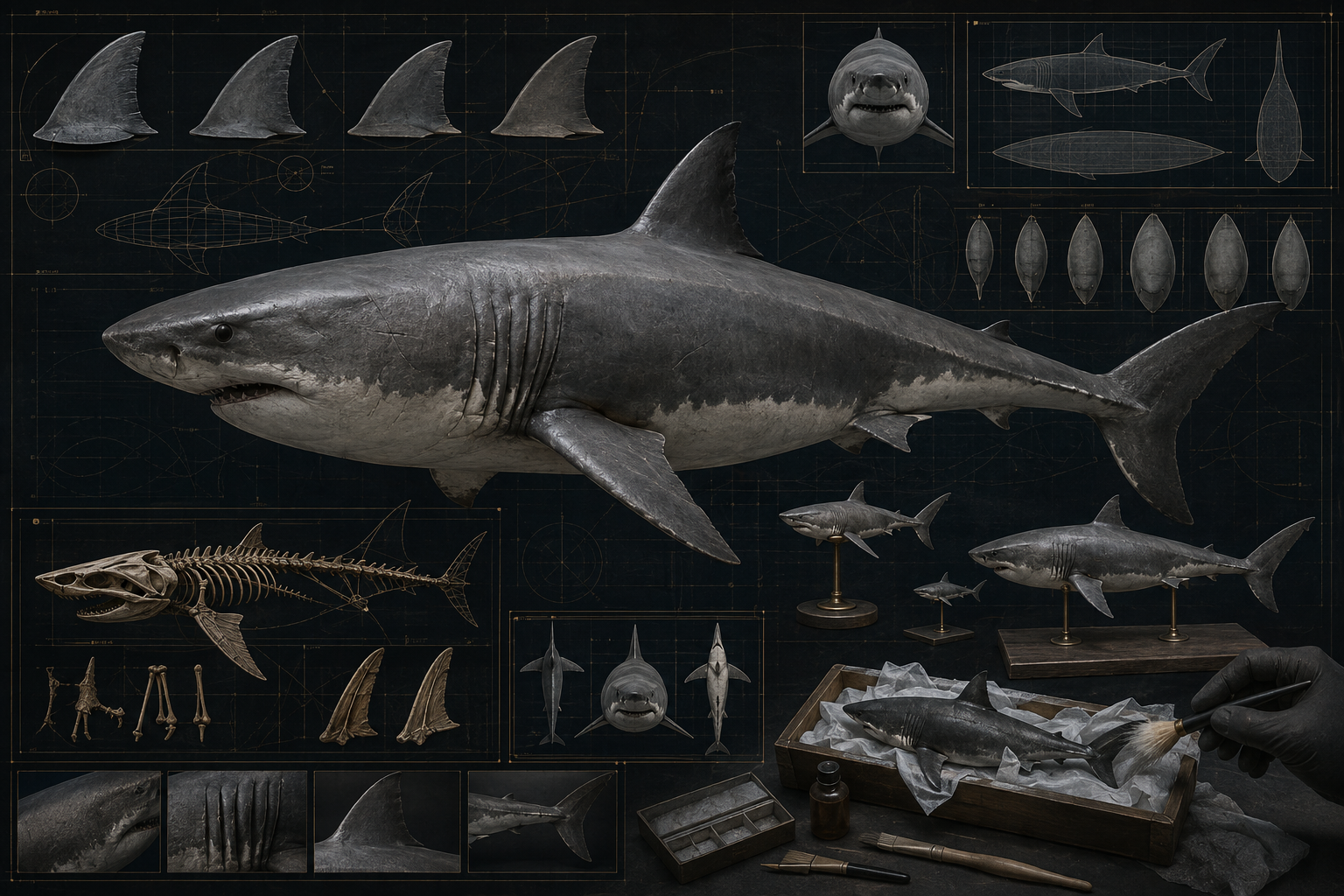
The wider cartilaginous fishes category adds context for explaining that sharks are part of a larger group defined by shared structural traits. Even a single scale model can help students identify what makes shark anatomy distinct, especially when the lesson focuses on fin arrangement, hydrodynamic shape, and the relationship between form and movement.
Scale Models and Responsible Preparation
For school displays, scale matters. A shark model that is too small may lose clarity in the fins or jaw outline, while a very delicate print can be harder to handle safely. Responsible print and display preparation means keeping thin fin edges durable enough for classroom use, choosing a stable support or mount if the pose needs one, and avoiding fragile details that distract from the anatomy lesson.
A Great White Shark model works best when it stays readable, durable, and clearly educational. Explore the Great White Shark category for a focused marine anatomy reference for school science.