German Shepherd 3D Models for 3D Printing: Stable Poses and Print Prep
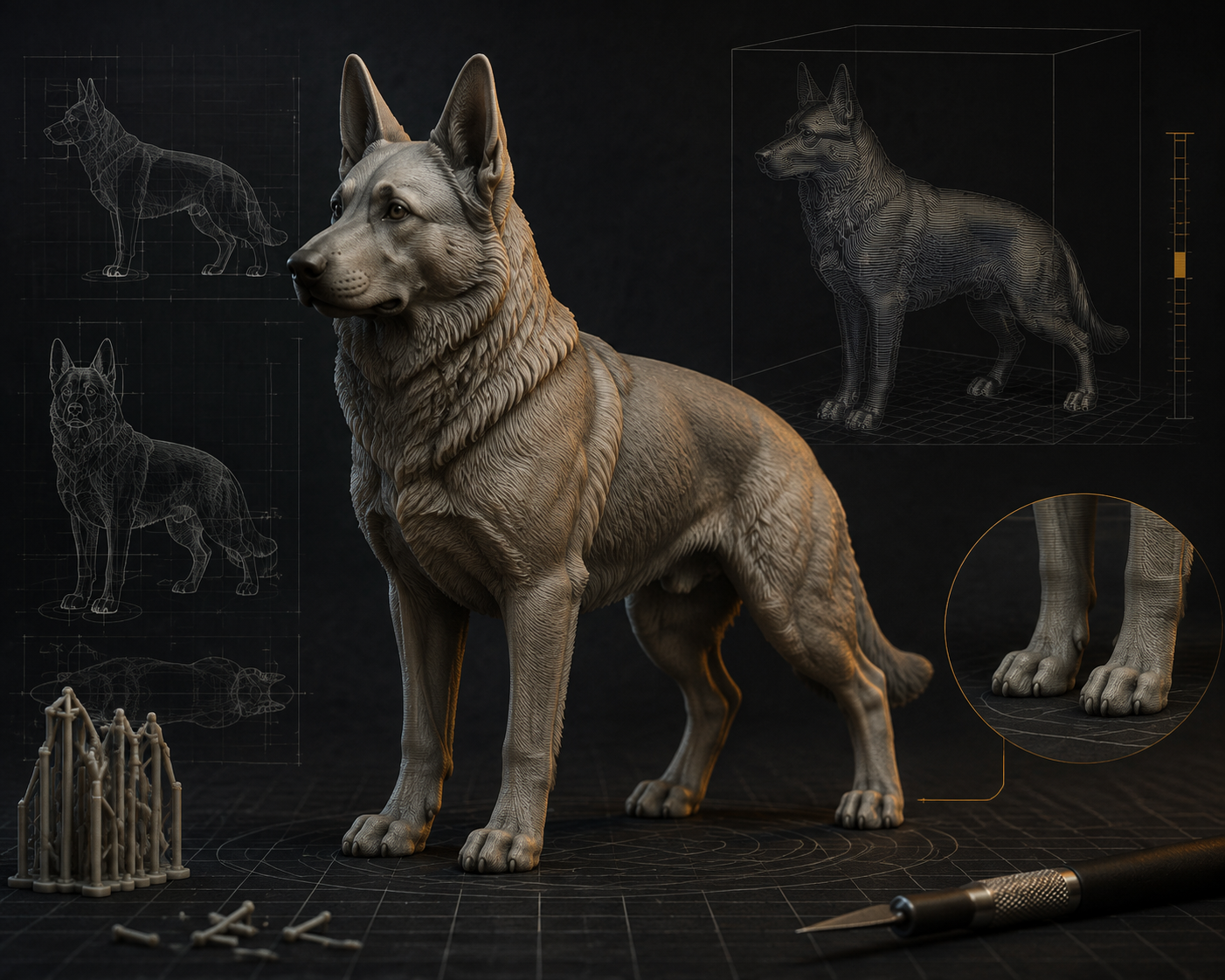
Start With a Pose That Can Actually Print
German Shepherd figures are easiest to print when the pose is stable before any slicer settings are considered. For this breed, that usually means all four paws are clearly grounded, the body weight reads evenly, and the chest, pelvis, and head align in a way that does not create a top-heavy lean. A dramatic stride may look energetic on screen, but for a physical figure it can turn thin ankles and lifted paws into failure points.
That makes the German Shepherd category most useful when you evaluate stance first, then surface detail. The shoulder height, sloped topline, deep chest, and hindquarter angulation should still read as German Shepherd anatomy even in a simplified printable pose. If those landmarks are off, scaling the model up or down will not solve the underlying silhouette problem.
Watertight Geometry, Thickness, and Support Planning
Printable animal models need closed, watertight geometry and enough material where the breed naturally narrows. On a German Shepherd, the risky areas are the ear tips, tail, lower legs, and any sharp transitions around the jaw or toes. A tail that looks elegant in a render can become too fragile once printed small, and thin ear edges can chip during cleanup.
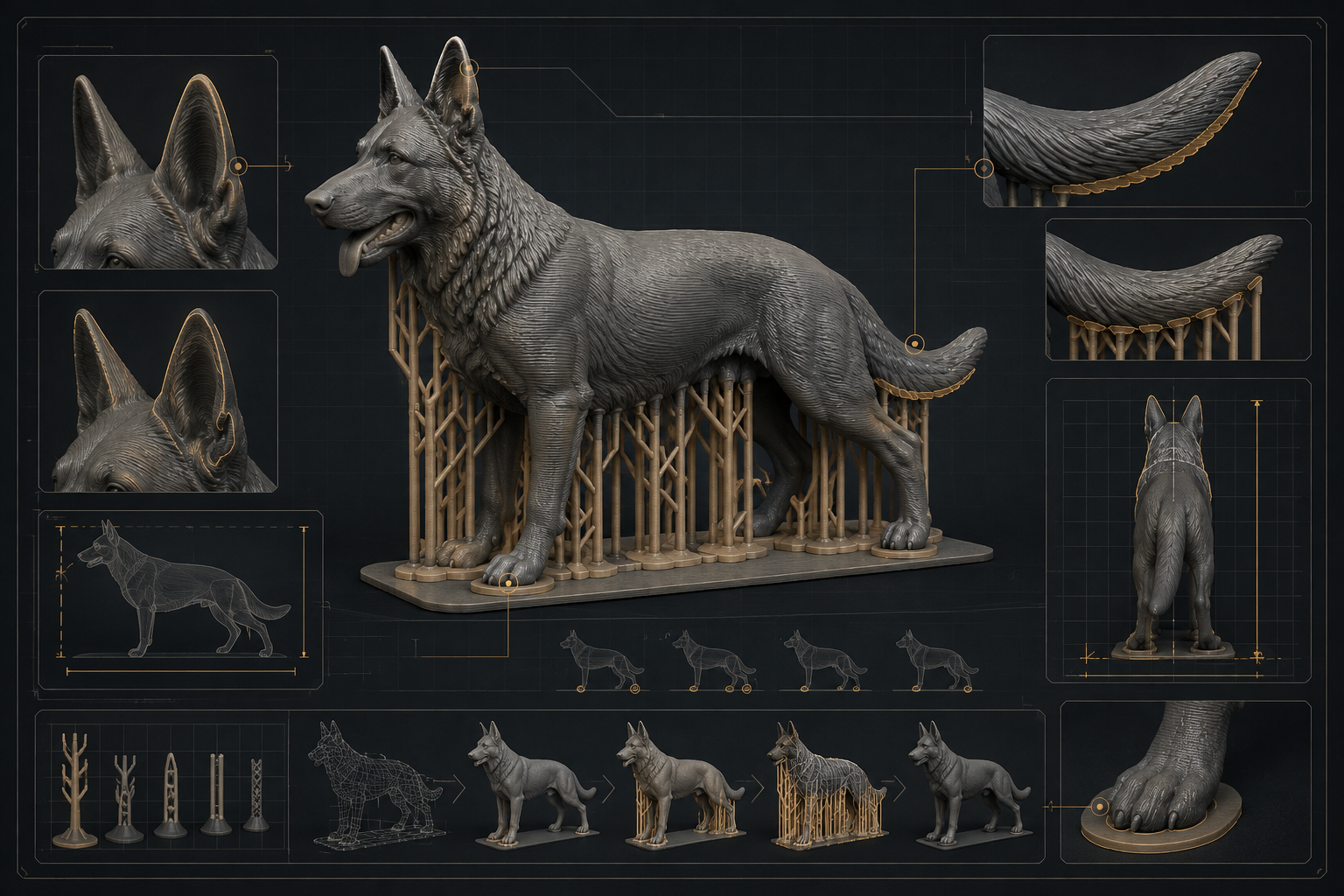
Support planning should follow anatomy instead of fighting it. If the paws are planted cleanly, fewer emergency supports are needed under the torso. If the tail hangs too far from the body or the ears extend as isolated points, the model may need either thicker forms or a revised pose. The broader domestic dog category is a useful comparison point because canine figures often fail in the same narrow zones even when breed proportions differ.
Scale and Anatomy for Display Figures
Scale changes what counts as enough structure. At small display sizes, toe separation, sharp fur edges, and thin tail ends often need to be simplified so the print survives handling and paint prep. At larger sizes, those same features can be preserved more clearly, but only if the mesh remains clean and the pose keeps the figure balanced on its base contact points.
For a printable German Shepherd, anatomy is not just a visual accuracy issue. It determines how the mass is distributed from forequarters to hindquarters and whether the finished figure feels intentional instead of precarious. Explore the German Shepherd category to compare the current two models for pose stability and print prep.