Bull Terrier 3D Models: Shape, Rigging and Print Use
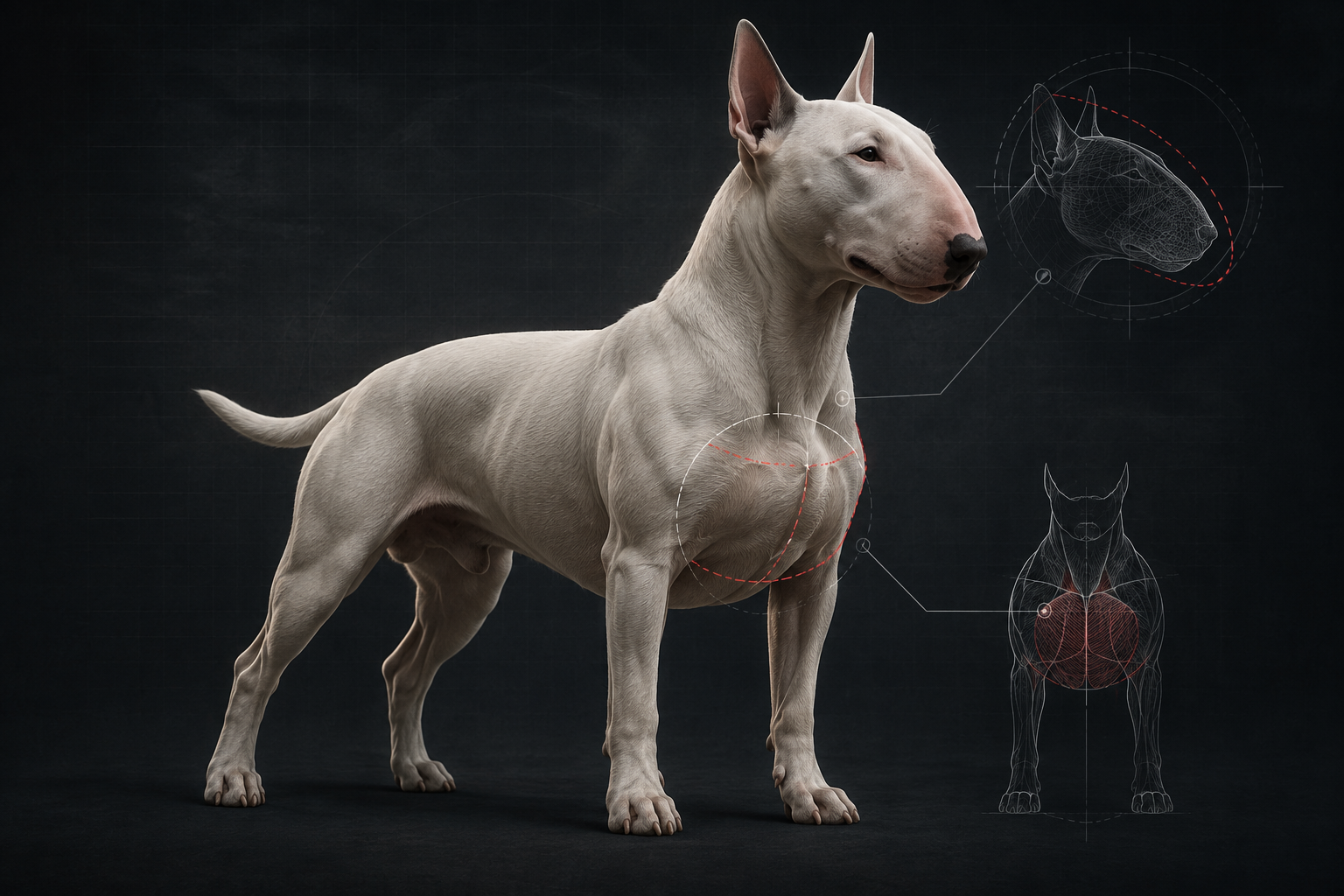
The Bull Terrier's egg-shaped head, compact muscular frame, broad chest, and upright stance make it easy to spot and just as easy to get wrong in 3D. If the skull breaks into a more conventional muzzle-and-stop pattern, or the body loses its dense front assembly, the model reads as a generic short-coated dog instead of a Bull Terrier. That makes silhouette accuracy the first filter when comparing breed options inside the wider Domestic Dog catalog.
Shape and Topology Priorities
This breed depends on continuous surfaces more than sharp facial landmarks. The head profile should flow from crown to nose without a strong stop, while still leaving enough structure around the eyes, jaw hinge, and lips for clean shading. On the body, the chest needs real volume and the neck should transition into the shoulders without feeling tubular. A mesh that captures those mass relationships will usually hold up better in still renders than one that spends triangles on minor skin detail.
Topology matters most where the Bull Terrier bends or turns: around the jaw, base of the neck, shoulder pocket, elbows, and front pasterns. Clean loops in those areas help preserve the breed's heavy-fronted look during posing. For close renders, the short coat means form does most of the work, so proportion and surface continuity are more useful than noisy sculpt texture.
Rigging and Pose Selection
Bull Terriers are not built like narrow athletic dogs, so the rig should support weighty stance changes rather than exaggerated stretch. A useful setup gives enough control in the neck, shoulders, chest, and spine to keep the dog square and balanced in alert standing poses, slow turns, or restrained movement studies. If the shoulders collapse inward or the chest narrows during deformation, the breed character disappears quickly.
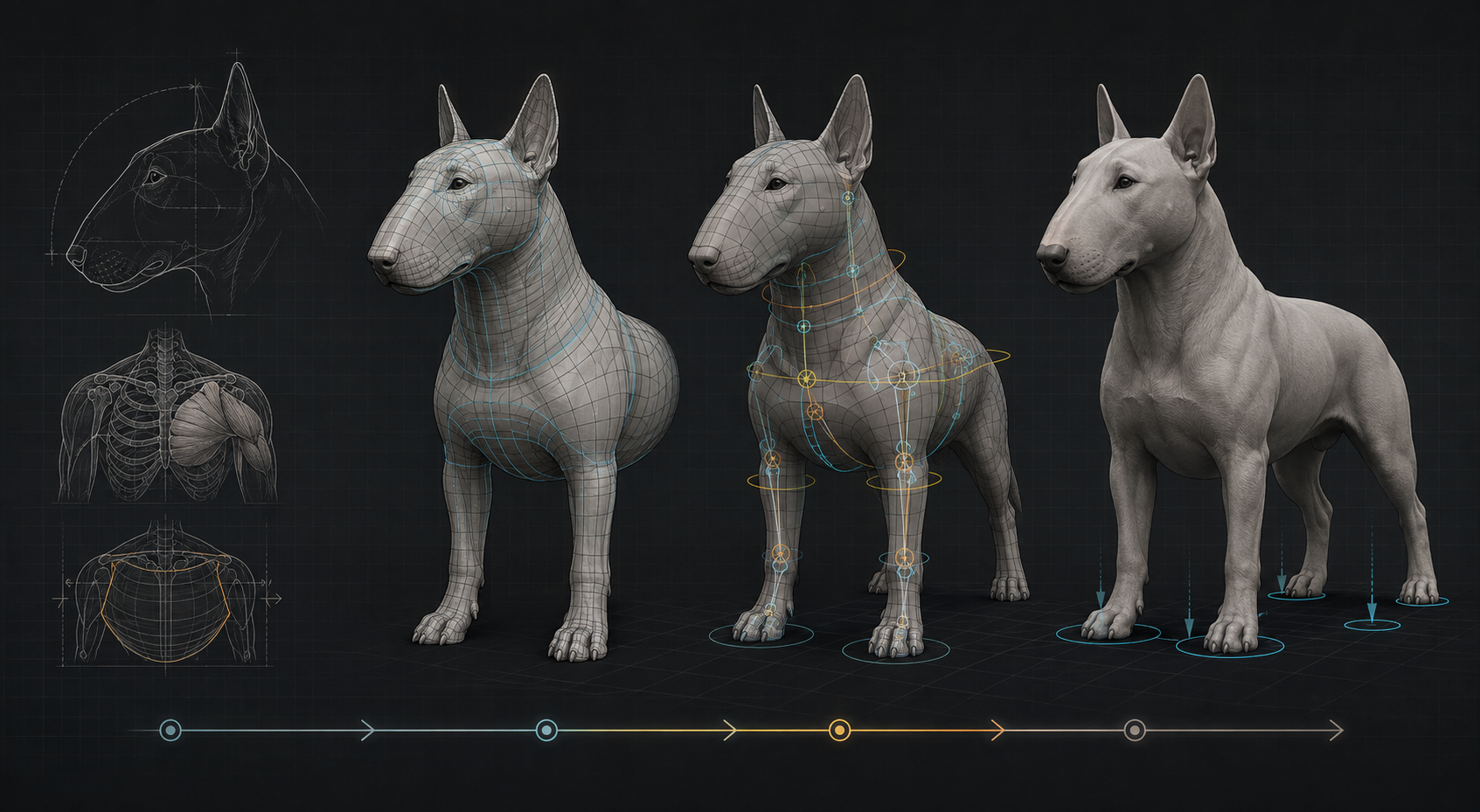
Pose choice follows the same logic. An upright planted stance usually shows the breed better than a generic run cycle because it keeps the head mass, forequarter width, and straight-ahead posture readable. That also connects well to the broader guidance in Dog 3D Models for Animation, Games & 3D Printing, where the right use case depends on anatomy first.
Print Use and Stability
For physical output, the practical checkpoints are paw contact, leg spacing, and unsupported thin parts. Bull Terriers are relatively favorable for printing because the torso is compact and the chest sits over sturdy front limbs, but the tail, ear tips, and any lifted paw can still create fragile points. A standing pose with grounded feet and controlled undercuts is usually more reliable than a dramatic twist.
For rendering, prioritize the head curve, chest depth, and stance. For print use, prioritize contact and thickness. Browse the Bull Terrier category to compare the current five models by silhouette and production fit.